
Most Columbia homeowners who ask us about tree laws are really asking one of two things. Can I take this tree out without trouble from the city? And can the city make me take it out?
The honest answer to both is “it depends on the tree and where it stands.”
Dead and Hazardous Trees Can Be a Code Violation
Columbia Code of Ordinances, Section 11-230 (Nuisances enumerated)
A tree on private property can become a city problem when its condition threatens public safety. Section 11-230 declares each of these a nuisance:
- A tree or limb that is dead and is a hazard to life or property
- A tree or limb that causes a safety hazard by blocking the line of sight of a driver, bicyclist, scooter rider, or pedestrian at a street intersection
- A tree or limb that could interfere with the passage of vehicles, bicycles, scooters, or pedestrians on a public right-of-way
- A tree that harbors insects or disease that are a potential threat to other trees
The same section also declares any condition on public or private property that is injurious or dangerous to public health or safety a nuisance, which is broad enough to reach a living tree that’s a real danger.
Under the first of those, a dead tree has to be a hazard to life or property. Dead alone isn’t enough, unless the tree also blocks a right-of-way or harbors pests or disease that threaten other trees.
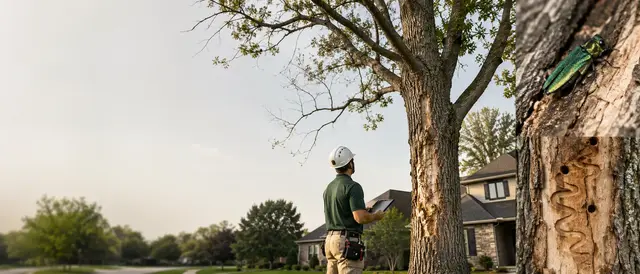
A standing dead tree in an isolated wooded corner carries little risk. A dead tree leaning toward a house, driveway, sidewalk, or the neighbor’s fence is a different animal. Whether the city treats a particular tree as a violation is the city’s call. How likely the tree is to fail, what it would hit, and who or what is underneath all matter.
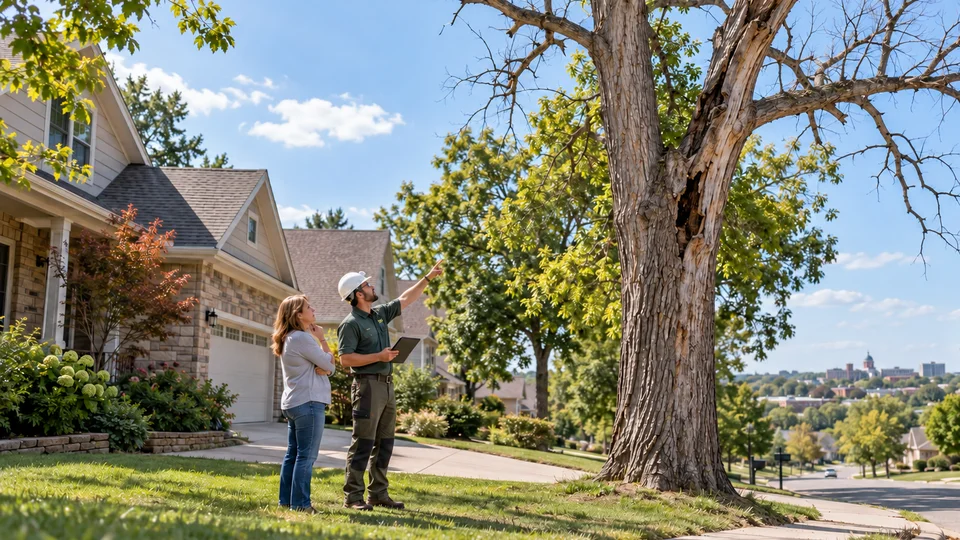
That’s a judgment call a certified arborist makes on site. Pruning, monitoring, and removal are all legitimate outcomes. If you’re weighing that decision, our post on when a tree needs to come out walks through the warning signs.
What Happens If the City Sends a Notice
Columbia Code of Ordinances, Section 11-240 (Administrative procedure)
For nuisances that don’t have their own abatement procedure, Section 11-240 lets the city’s enforcement official serve the owner with an abatement notice. The notice has to describe the nuisance, state what must be done to abate it, and set the time to start and finish the work.
If your notice is governed by Section 11-240, you can contest it, but the written hearing request must reach the Director within seven days of service. Mailed notice is presumed received three days after mailing. If the nuisance isn’t abated as ordered and no hearing is requested in time, the city may abate it and assess the costs against you and the property. A hearing officer’s decision can be appealed to the Boone County Circuit Court.
The city’s separate public health nuisance page describes a seven-day correction window for conditions like weeds and trash, and it doesn’t mention trees. Read the notice you receive and go by the dates on it.
Ignoring a known hazardous tree can cost you more than property damage. If a tree-related notice lands in your mailbox, contact the city department named on it right away and ask exactly what correction is required and by when. Don’t wait on a crew’s schedule to call.
Can You Remove a Tree From Your Own Yard in Columbia?
Columbia Code of Ordinances, Section 29-4.4(b) and (g)(1)
For owners of established single-family homes, Columbia’s tree preservation ordinance is less restrictive than most people assume. Section 29-4.4(b)(2) exempts single-family, two-family, and live-work lots from the general provisions in subsections (c) and (e), and Section 29-4.4(g)(1) exempts building a single-family or two-family home from the preservation standards in subsection (g). The one-acre limit in Section 29-4.4(b)(3) applies only to that subsection (g) exemption: it covers single-family and two-family structures on platted lots under one acre, and it doesn’t change the (c) and (e) exemption.
That doesn’t mean anything goes. Before you cut, check four things:
- Is the tree in a public right-of-way or easement?
- Does a recorded easement or approved plan restrict what you can do on the property?
- Is the work part of clearing trees on a tract of one acre or more?
- Does another permit or restriction cover what you’re planning?
If the answer to all four is no, the city’s development-related preservation rules generally shouldn’t be read as a ban on removing a healthy tree from an ordinary residential lot.
Street Trees and the Sidewalk Strip
Columbia Code of Ordinances, Section 29-4.4(c)(12) and Chapter 24, Article V
The tree between your sidewalk and the street may not be yours to cut. Section 29-4.4(c)(12), part of the city’s development landscaping rules, says tree selection, planting, removal, and pruning within city rights-of-way and easements must comply with Chapter 24, Article V, or have the City Arborist’s approval. That subsection sits in the part of 29-4.4 that single-family lots are exempt from, so how it applies to a homeowner’s street tree is a question for the City Arborist.
Article V itself is mostly about planting. Section 24-87 makes it unlawful to plant landscape material on public street right-of-way without a permit from the Director of Public Works. Section 24-92 limits plantings to the city’s approved list or species the director approves (native or adaptable to the region), and requires root barriers for trees in a sidewalk-to-curb strip of four feet or less, unless the species is listed as not needing one. It also bans hedges between the sidewalk and curb.
Article V also puts upkeep on the adjoining property owner. Under Section 24-95, that includes removing dead plant material and trimming trees and bushes to the city’s clearance standards, and the city may remove landscape material that isn’t properly maintained. Under Section 24-94, a street tree that was already there in 1994 may stay unless the director finds it obstructs sight distance, interferes with utilities or street lights, or endangers public safety.
This comes up most when homeowners want to:
- Remove a declining street tree
- Prune branches hanging over the roadway
- Plant a replacement between the sidewalk and curb
Confirm where the tree sits, and what the city requires, before any of that work starts. The city’s right-of-way tree planting permit application is the place to start for a replacement.
Big Trees and Development
Columbia Code of Ordinances, Section 29-4.4(g)(3) and (g)(4)
Development projects get a separate set of rules, and these are the ones people tend to mix up with ordinary tree removal. Subsection (g) applies to development and redevelopment on lots of 10,000 square feet or more. It doesn’t apply to building a single-family or two-family home, though under Section 29-4.4(b)(3) that subsection (g) carve-out covers only platted lots under one acre.
For a deciduous tree, the ordinance’s “significant tree” threshold is a tree that:
- Measures at least 20 inches in diameter at breast height (DBH)
- Is not diseased, dying, or a noxious invasive species
- Stands outside a tree preservation area, stream buffer, or utility easement
During development or redevelopment, 25% of significant trees must be preserved. When a significant deciduous tree is removed in that setting, the owner must replace it with three large-to-medium deciduous trees, each at least two inches in caliper at planting. A significant conifer has its own rule: two conifers, each at least eight feet tall. Replacement trees of either kind must be maintained for at least three years. The alternative is a $750-per-tree payment to the city’s right-of-way landscaping budget for public street trees.
Those rules attach to development and redevelopment, which includes additions and alterations that need a land disturbance permit, and subsection (g)(3) also says all vacant and undeveloped land must abide by it. On an established home lot, taking down a single tree generally isn’t development. But if the lot is vacant or the removal is tied to a building project, ask the City Arborist whether subsection (g) applies.
Protecting roots during construction
Section 29-4.4(g)(4) requires tree protection before and during site disturbance on covered projects:
- No activity that could damage tree roots within 20 feet outside the drip line of trees being preserved
- Orange construction fencing around the preservation area, with “Tree Preservation - Keep Out” signs every 100 feet
- No construction, grading, equipment, or material storage inside the fence
- City Arborist inspection and approval before land-disturbing work starts
The reason is that roots reach well past the trunk and the edge of the canopy. Heavy equipment, soil compaction, trenching, and a change in grade can wreck them while the trunk and branches look untouched. The damage often doesn’t show for several growing seasons, and by then the tree is declining and nobody connects it to the project.
Clearing a Wooded Lot
Columbia Code of Ordinances, Section 29-4.4(i)(1) through (3)
Larger wooded properties carry the strictest requirements. Under Section 29-4.4(i)(1), clearing or logging trees four inches DBH or larger on tracts of one acre or more is unlawful without a land disturbance permit, logging permit, or tree preservation plan.
Section 29-4.4(i)(2) also requires preserving at least 25% of any climax forest on a tract of an acre or more, and Section 29-4.4(i)(3) caps how much climax forest successive logging can remove. These are separate from the significant-tree rules in subsection (g).
Where logging happens before a tree preservation plan is approved, Section 29-4.4(i)(3) requires a logging plan, submitted to the City Arborist, showing that 25% of the climax forest will be preserved. Ask the City Arborist which permit applies to your tract.
If you’re planning to clear a lot for construction or anything else, find out what applies first. Clearing now and sorting out permits afterward is how a simple project turns expensive. Our post on the hidden costs of a wooded lot in Missouri covers what else tends to surprise owners, and our land clearing page explains how we handle those projects.
When to Call a Certified Arborist
Not every declining tree has to go, and not every healthy-looking tree is sound. Get a professional evaluation if a tree:
- Has significant dead branches over a home or driveway
- Develops large cracks, splits, or cavities
- Shows root damage or instability
- Starts leaning when it didn’t before
- Lost major limbs in a storm
- Shows signs of disease or insect infestation
- Stands near structures, utilities, or heavily traveled areas
Every job at Tree Wizard is reviewed by Chris Haubner, ISA Certified Arborist MW-4356A. He can tell you whether a tree needs corrective pruning, monitoring, treatment, or removal.
We can point you toward the right city office, but we aren’t your lawyer, and permit decisions belong to the City. We’ve been family-owned in Columbia since 2003, and we’d rather tell you a tree can stay than sell you a removal it doesn’t need.
Concerned about a dead, damaged, or hazardous tree? Call (573) 442-1838 or browse our Columbia, MO tree services.
Request a free tree assessment →
City Ordinances and Resources
Ordinances cited:
- Section 11-230: Nuisances enumerated
- Section 11-240: Administrative procedure (abatement notices)
- Section 29-4.4(b) and (g)(1): Applicability and residential exemptions
- Section 29-4.4(c)(12): Trees within city rights-of-way
- Section 29-4.4(g)(3): Significant-tree preservation and replacement
- Section 29-4.4(g)(4): Tree protection during construction
- Section 29-4.4(i): Clearing of trees and climax forest preservation
- Chapter 24, Article V (Sections 24-86 through 24-95): Landscape Planting in Public Right-of-Way
Official resources:
- City Clerk: Code of Ordinances, the city’s entry point to the code, including Chapter 11, Chapter 24, and Chapter 29
- Section 29-4.4, Landscaping, Screening, and Tree Preservation
- City Arborist and tree resources
- Right-of-way tree planting permit application
- Logging permit application
- Public health ordinances and nuisance enforcement
This article is general educational information, not legal advice, and Tree Wizard can’t guarantee that any permit will be approved. Requirements depend on the property, its location, and the work being done, and the city’s online code may differ from the official version kept by the City Clerk. Confirm current requirements with the City of Columbia before any regulated tree work.
Frequently Asked Questions
Do I need a permit to remove a tree from my yard in Columbia, MO?
For an ordinary tree on an established single-family lot, Columbia's tree preservation rules generally are not a blanket ban on removal. Trees in the public right-of-way, properties with recorded easements or plan restrictions, and larger tracts being cleared are different. Confirm the details with the City of Columbia before work starts. We can help you size up the tree, and you can reach us at (573) 442-1838.
Can the city make me remove a dead tree?
It can happen. Section 11-230 declares a dead tree or limb that is a hazard to life or property a nuisance, and a dead tree that isn't a hazard doesn't fit that wording. If the notice falls under the general administrative procedure in Section 11-240, a written hearing request must reach the city within seven days of service. Follow the instructions and deadlines on your specific notice.
Who handles the tree between my sidewalk and the street?
The strip between the sidewalk and curb is often city right-of-way. Chapter 24, Article V of the City Code requires a permit to plant there and makes the adjoining owner responsible for keeping plantings trimmed and free of dead material, and the city's development code routes right-of-way tree work through Article V or the City Arborist, though how that applies to a single-family lot is a question for the City Arborist. Confirm the tree's location and call the city before you cut anything.
Do I need a permit to clear a wooded lot in Columbia?
Possibly. On tracts of one acre or more, clearing or logging trees four inches DBH or larger requires a land disturbance permit, logging permit, or tree preservation plan, and at least 25% of any climax forest on the tract must be preserved. Talk to the City Arborist before the first tree comes down.