
★★★★★ G
"Chris and his crew did phenomenal work for us! They gave us a quote and were out within the week to take down…"
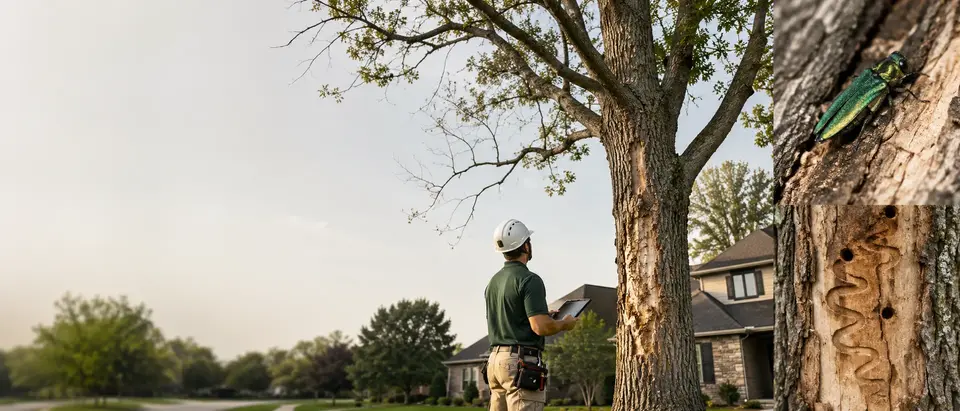
EAB has killed millions of ash trees across Missouri — and it's established in Columbia, MO and throughout Boone and Callaway counties. Early treatment is the only option. Once infestation progresses past a certain point, removal is the only answer. Tree Wizard evaluates ash trees and treats those still worth saving.
Emerald Ash Borer arrived in Missouri in 2008 and spread quickly. It's now confirmed throughout Boone and Callaway counties. Every ash tree in the Columbia area is at risk — there are no EAB-free zones in Central Missouri anymore.
The beetle's larvae feed on the tissue beneath the bark that transports water and nutrients. An infested tree is essentially being starved from the inside. The process is slow enough that visible symptoms often appear late — by the time a homeowner notices canopy dieback, the tree may already be beyond treatment.
Ash trees have compound leaves with 5–9 leaflets in opposite pairs, diamond-patterned bark on mature trees, and distinctive paddle-shaped seed clusters (samaras) that hang in bunches. If you're not sure, have us take a look — not every tree with yellow leaves in fall is an ash.
D-shaped exit holes in the bark (about 1/8 inch wide), S-shaped galleries visible when bark is peeled back, canopy dieback starting at the top and progressing downward, bark splitting or sloughing off, heavy woodpecker activity, and epicormic shoots (sprouts) from the trunk base are the key indicators.
An untreated, infested ash typically dies within 3–5 years of initial infestation. The timeline varies by tree size and health going in. Early detection and treatment can extend the tree's life indefinitely with continued treatment cycles; late-stage infestation cannot be reversed.
The standard threshold is 50% canopy remaining. Below that, the tree's vascular system cannot support treatment uptake and recovery. A certified arborist assesses each tree individually — canopy loss isn't the only factor, but it's the most reliable indicator.
The right call depends on your tree's condition, its location on your property, and what matters to you. Here's how we think through it:
We don't recommend treatment for trees that won't benefit from it. If we tell you to remove it, that's the honest answer.
Trunk injection is the most effective treatment method for established trees. The chemical is injected directly into the vascular system, where it's carried throughout the tree. Injection treatments typically protect for two years and have the best efficacy data of any EAB treatment method.
Soil drench applications are another option for certain sites — particularly where access for injection equipment is limited. Systemic uptake through the roots can be effective, though efficacy and timing requirements differ from injection.
Our certified arborist evaluates your tree and recommends the appropriate method. We don't apply a one-size approach — treatment protocol depends on tree size, site conditions, and infestation stage.
EAB-killed ash trees become structurally unpredictable within 2–3 years of death. The wood dries unevenly, becomes extremely brittle, and can drop major limbs without warning. A dead ash near a structure, driveway, or area where people spend time is a serious hazard.
The window for safe, cost-effective removal closes faster on ash than most species. A dead ash that costs $1,500 to remove today may cost considerably more — and require a crane — in two years when the wood has deteriorated further. If you have a dead ash, call us sooner rather than later: (573) 442-1838.
"Chris and his crew did phenomenal work for us! They gave us a quote and were out within the week to take down…"
"Tree Wizard did an excellent service to my trees. Completed their work efficiently. Cleaned up completely. Whe…"
"They got an emergency job done for me while I was out of town. Got the mess out and the damage covered before…"
"Tree wizard was awesome! Quick response to my request for a quote and then they came out and finished the job…"
"I highly recommend Tree Wizard. Excellent customer service and communication. The team did a beautiful job on…"
"Fantastic job and a fair price. They did their work quickly and did a good job on clean up. Chris was fantasti…"
"Everything from the estimate to work completion was first class! All employees were professional and nice. Not…"
"Amazing service. Got a quote on Friday and they were out the next Monday. Very professional and considerate of…"
"The Tree Wizard staff from Teri that answered my call to the two guys that cut the huge pine tree in my backya…"
"Tree Wizard was AMAZING! They were able to get my 60ft tree removed in just one day!! They even were kind enou…"
Tell us about your tree situation and we'll get back to you promptly.