


★★★★★ G
"I needed 27 trees planted. They worked quickly, professionally, did everything needed (composting, mulching) a…"
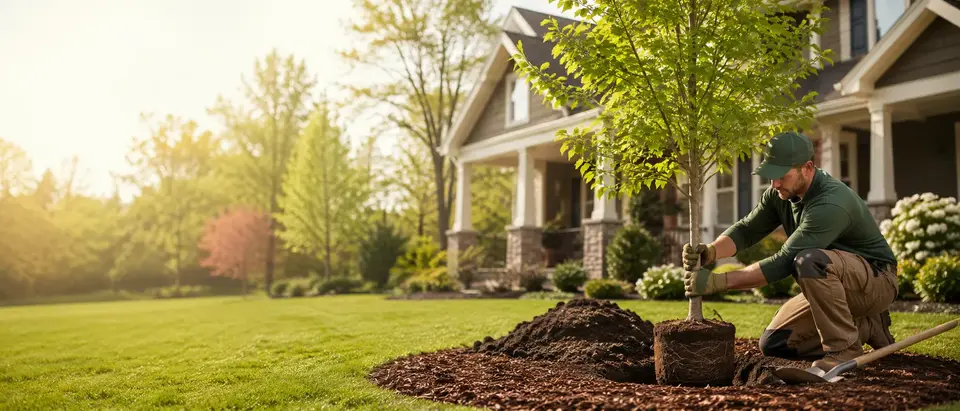
Planting the wrong tree in the wrong spot creates problems for decades. Tree Wizard helps Columbia, MO homeowners choose the right species for Missouri's climate, plant correctly from day one, and get the aftercare right so the tree establishes well.
Most tree problems that show up 5 or 10 years after planting have their roots in how the tree was installed. The two most damaging mistakes are planting too deep and choosing the wrong species for the site.
A tree planted with its root collar buried develops girdling roots and crown rot that take years to show up. By the time the tree looks sick, it's usually too late to fix. Correct depth — root collar at or slightly above grade — is the single most important factor at planting time.
Columbia's summer heat, clay soils, and Missouri's weather swings eliminate many species that look fine in a nursery. Choosing a tree that fits your specific conditions — drainage, overhead lines, mature canopy spread, sun exposure — determines whether it thrives or struggles.
Bradford pear is still sold at nurseries in Missouri, but it's invasive and structurally dangerous. The tree splits under ice and wind loads and seeds aggressively into natural areas. We won't plant them, and we'll suggest better alternatives with similar spring bloom.
Even a correctly planted tree can decline if watering is neglected in the first two growing seasons. We walk you through exactly what the tree needs — watering schedule, mulch ring, whether staking is appropriate — so you know what to do after we leave.
Central Missouri has a distinct climate: cold winters, hot humid summers, periodic drought, and clay-heavy soils in most neighborhoods. Native and well-adapted species handle these conditions without the management problems that out-of-range trees develop.
White oak, bur oak, and red oak are Missouri natives that grow into large, long-lived shade trees. They handle clay soils and summer drought once established. Slow early growth is a tradeoff — a bur oak planted today will outlive the house.
Sugar maple provides excellent fall color and adapts well to Columbia's conditions. Avoid silver maple — it grows fast but has brittle wood that breaks in storms and aggressive surface roots. Red maple is a middle-ground option.
American redbud is one of the best small-to-medium trees for Missouri — native, early spring bloom, tolerates shade, and stays at a manageable size. Serviceberry is another excellent native with spring flowers and wildlife value.
Ash (Emerald Ash Borer), Bradford and Callery pear (invasive, structurally weak), and silver maple (weak wood, aggressive roots). We'll suggest alternatives for anything on this list that a nursery may have recommended.
If we removed a tree from your property, replacement planting is the natural next step. The gap in your canopy, shade pattern, and property character can be filled — but the right choice depends on why the tree came down, what's in the ground from the old root system, and what you want the yard to look like in 20 years.
We help with species selection based on the specific spot: proximity to structures, overhead utility lines, soil drainage, how much sun the area gets, and how large you want the mature canopy. Ask us to include a replacement planting recommendation on your removal estimate.
Fall planting (October through November) is our first choice. Cooler air temperatures reduce stress while soil temperatures stay warm enough for root establishment before freeze. The tree goes dormant above ground but continues building roots through early winter.
Spring planting before bud break (March–April) is also excellent. Summer planting works but requires consistent watering and carries more transplant stress in Central Missouri's heat. We plant throughout the growing season — reach out and we'll advise on timing for your specific situation.
"I needed 27 trees planted. They worked quickly, professionally, did everything needed (composting, mulching) a…"
"I hired Tree Wizard for tree trimming, and they did an outstanding job. The team was professional, punctual, a…"
"Tree wizard was awesome! Quick response to my request for a quote and then they came out and finished the job…"
"We are so thrilled with the work done at Old Auxvasse-Nine Mile Presbyterian Church. They cut down 3 trees and…"
"They are wonderful people! They brought down 4 of my parent's trees — one was in a very hard spot. They got th…"
"Chris and his crew were working on an emergency basis after the tornado tore down my street. They removed some…"
"Tree wizard did a great job for me trimming a tree and removing some other ones. I would definitely use them a…"
"Tree Wizard was AMAZING! They were able to get my 60ft tree removed in just one day!! They even were kind enou…"
"Pricing was very reasonable, the crew was easy to talk to and very knowledgeable, and the timing of the job wa…"
"Chris and his team are second to none. Great work ethic, great team, great equipment. Would trust them to do a…"
Tell us about your tree situation and we'll get back to you promptly.