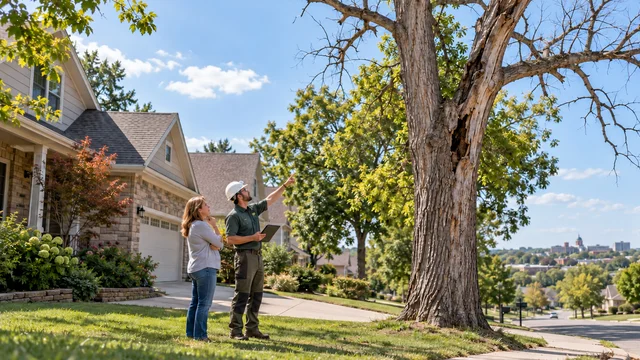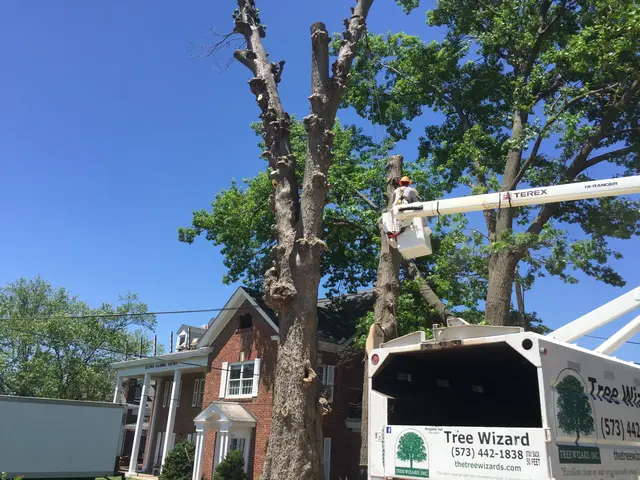

After 20 years of assessing trees in Columbia and the surrounding area, I’ve seen what happens when a hazardous tree goes unaddressed, and it’s not just inconvenience. Fallen trees destroy roofs, crush fences, land on cars, and occasionally injure people.
The challenge is that most homeowners can’t tell the difference between a tree that looks rough but is structurally sound, and one that’s quietly failing. A tree can look full and green right up until the moment it comes down.
Here are the seven signs I look for when someone asks whether their tree needs to come out.
1. Dead or Dying Branches Cover More Than 25–30% of the Canopy
A tree with a few dead branches isn’t automatically a problem. Trees shed lower limbs as they age, especially when those branches get shaded out by upper growth. That’s normal.
But when a significant portion of the canopy is dead or declining (I use 25–30% as a rough threshold), that usually means the root system is struggling. Dead wood above ground often reflects root failure below. It’s also a liability: dead branches break without warning, sometimes in calm weather with no wind at all.
If you’re seeing widespread dieback that isn’t explained by storm damage or an obvious disease, it’s worth having someone look at it before it gets worse.
2. Cracks, Cavities, or Soft Decay in the Trunk
A small surface cavity isn’t necessarily a death sentence. Trees compartmentalize decay. They wall off damaged tissue and keep growing around it. But there’s a meaningful difference between a shallow scar and a trunk that’s rotting through.
Things that concern me:
- Soft, punky wood when you probe a cavity with a screwdriver
- Cracks running vertically along the trunk for several feet
- Conk (shelf fungus) growing from the trunk: that signals active internal decay
- Seeping wounds that show no sign of closing after a full season
Decay near the base of the trunk is especially serious. That’s where the tree bears the most load under wind and ice.
3. The Tree Is Leaning Toward a Structure, Road, or Power Line
Not all lean is a problem. Trees in open areas lean toward light without any structural issue at all. What matters is the direction, whether the lean is new, and what’s in the fall zone.
A sudden new lean, especially after heavy rain or high winds, is a red flag. That often indicates root failure or soil saturation on one side. Look at the root plate at the base: if you see soil heaving or lifting, that tree is already starting to go.
Any lean toward a house, road, play area, or power line gets a hard look from me regardless of how healthy the canopy looks above. The canopy doesn’t tell you what’s happening at the roots.
4. Root Damage or Soil Heaving at the Base
This one is easy to miss because the damage happens underground. Construction work, utility trenching, and heavy equipment compacting soil near a tree can sever a third or more of the root system without touching the trunk. The tree may look completely fine above ground for two or three years while it slowly starves and loses structural anchor.
Watch for:
- Soil lifting or heaving near the base of the trunk
- Mushrooms growing from the roots (not from the lawn, from the roots themselves)
- A sudden lean that appeared after nearby work was done
- Dieback that starts at the branch tips and works inward
Root damage often shows up on the opposite side of the tree from where the work happened, because roots spread far beyond the canopy edge.
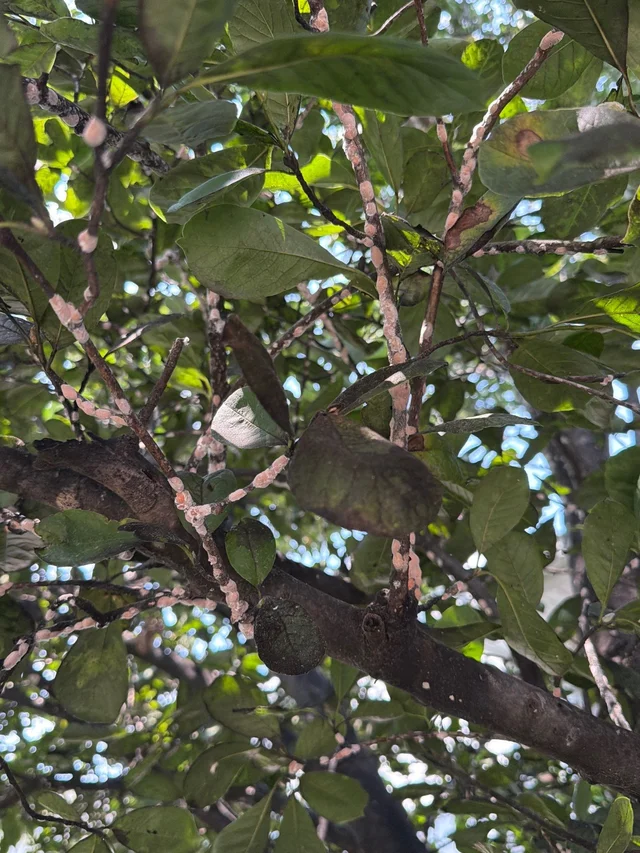
5. Disease or Pest Infestation That’s Beyond Treatment
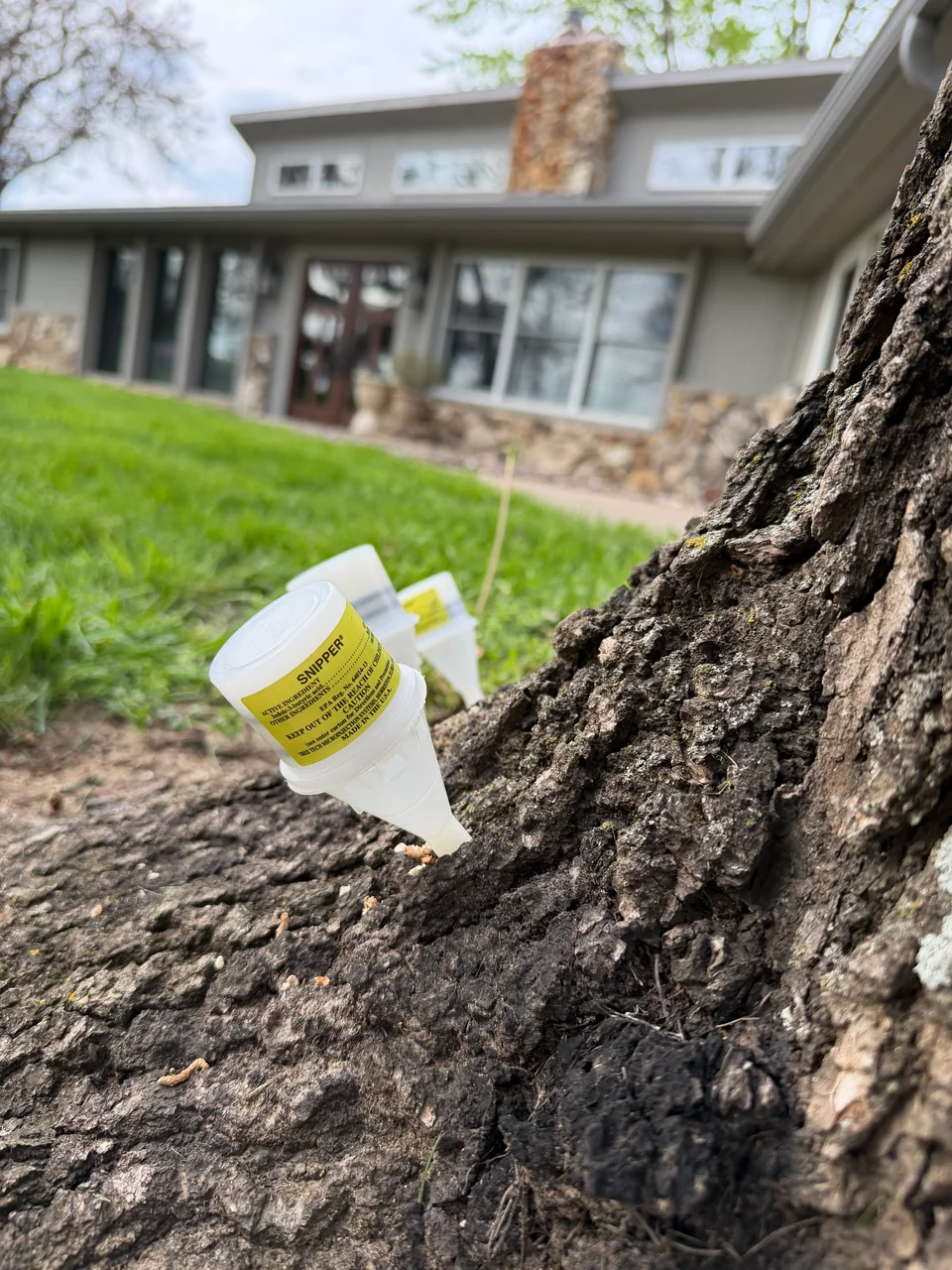
Some tree problems are manageable. Emerald ash borer is treatable with annual trunk injections if you catch it before canopy dieback exceeds about 30–40%. We treat a lot of ash trees here in Columbia successfully, and a well-timed treatment program can keep a valuable ash healthy for decades.
But at some point, treatment is throwing money at a tree that’s already dying. If an ash has lost 50% or more of its canopy to EAB, it’s declining faster than treatment can reverse. The same goes for severe oak wilt, extensive canker disease, or a tree that’s been heavily defoliated multiple consecutive years.
As an ISA Certified Arborist, I can give you an honest assessment of whether treatment makes financial sense for your specific tree, or whether removal is the smarter call.
6. Co-Dominant Stems with Bark Inclusion
This is something most homeowners walk past every day without knowing it’s a structural problem.
Co-dominant stems are two or more main stems growing from the same point on the trunk. The issue is when bark gets wedged between those stems as they grow, called bark inclusion. Instead of the stems fusing together with strong wood-to-wood contact, they’re essentially held together by compressed bark. That joint is weaker than it looks and can split under load.
This is especially common in ornamental trees, silver maples, and Bradford pears. A tree can grow this way for decades, looking perfectly fine, and then split during an ice storm or a summer thunderstorm.
It’s not always a reason to remove the tree immediately, but it needs to be monitored and, in many cases, cabled or addressed with structural pruning before the included bark leads to a split.
7. The Tree Is Creating an Ongoing Practical Problem
Sometimes the question isn’t whether a tree is safe. It’s whether keeping it makes sense long-term.
Roots lifting a foundation, a driveway, or a sidewalk. Constant debris filling a gutter. A tree so close to the house that branches are constantly rubbing the roof. Shade so heavy that nothing else will grow in the yard. These aren’t emergency situations, but they’re legitimate reasons to consider tree removal.
A healthy tree can still be the right tree to remove if the cost and hassle of keeping it is ongoing and significant.
Not Sure? Get an Assessment
Any of these signs is worth getting professional eyes on. At Tree Wizard, we assess trees at no charge as part of any estimate visit. I can usually give you a straight answer on the spot: remove it, treat it, or just keep an eye on it. Plenty of the trees I look at don’t need removal at all. They just need trimming on the right schedule.
That’s what an ISA certification is for: knowing the difference. Call (573) 442-1838 to schedule a visit, or learn more about our Columbia, MO tree services.
Frequently Asked Questions
How do I know if a tree needs to be removed or just trimmed?
A tree that's structurally sound but has overgrown branches usually just needs trimming. Signs that point toward removal include more than 25-30% dead canopy, active trunk decay, root failure (soil heaving at the base), or a new lean after heavy rain or wind. If you're not sure, a free assessment from an ISA Certified Arborist can answer the question on the spot.
Is a dead tree always dangerous?
Not immediately, but a standing dead tree is a liability that increases over time. Dead wood loses structural integrity faster than living wood, and dead trees don't have the warning signals (wilting leaves, visible lean) that give you notice before a living tree fails. Most dead trees within fall distance of a structure, driveway, or road should be removed.
What is bark inclusion and why does it matter?
Bark inclusion happens when two main stems grow so close together that bark gets trapped between them instead of fusing into strong wood-to-wood contact. The result is a weak joint that can split without warning under ice, wind, or the weight of the tree itself. It's common in silver maples and Bradford pears here in Columbia, MO.
Can I remove a tree myself in Columbia, MO?
Removing a small tree away from any structure is something some homeowners handle themselves. Anything near a house, fence, power line, or vehicle, or any tree over 20-25 feet, carries real risk of serious property damage or injury. Call (573) 442-1838 for a free assessment before making the call.