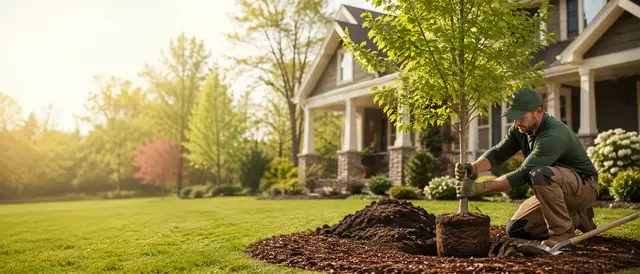

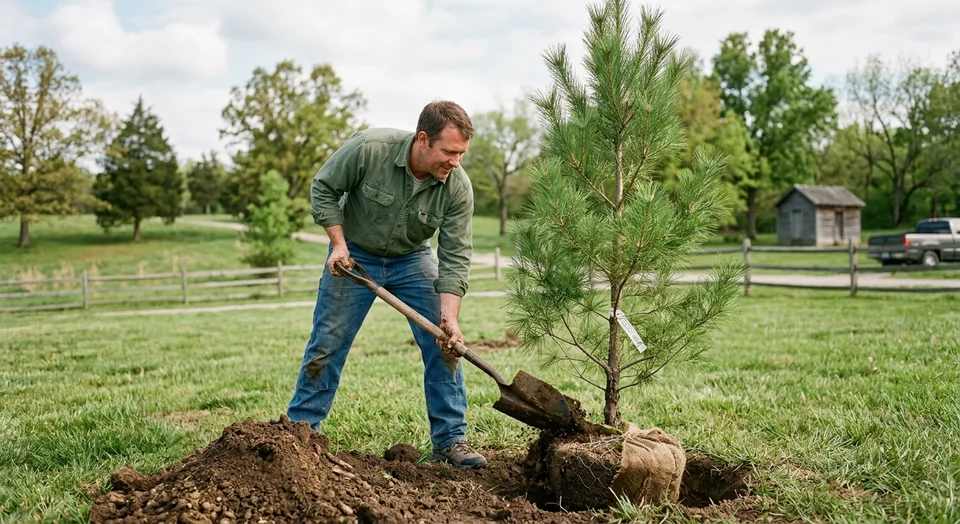
Every September I start fielding the same question: “Is it too late to plant a tree this year?” It’s not. Fall is actually the better half of the year to plant a tree, and this fall is shaping up to be a particularly good one.
This year’s extended outlook has late October running mild, which is about as good a setup as Columbia gets for getting a tree in the ground with minimal transplant stress. More on the actual numbers below.
Why Fall Is the Best Time to Plant Trees in Columbia, MO
A newly planted tree is under stress the moment it goes in the ground. The goal is to get it growing new roots as fast as possible, and fall gives it better odds than any other season:
- Cooler air slows water loss through the leaves, so the tree loses less moisture than it would in summer heat.
- Soil holds its warmth long after the air cools, so roots keep growing well into November.
- The tree needs less water overall than it would establishing in July or August.
- Deciduous trees are winding down leaf production and pushing more energy into roots.
A tree planted in October gets a full winter and spring of root establishment before it ever has to face a Missouri summer. University of Missouri Extension makes the same case for fall planting: cooler air, warm soil, and less transplant shock than a spring or summer install.
Reading Columbia’s Fall 2026 Outlook
Most people plant off a gut feeling about when it’s getting cold. The actual math says otherwise.
NOAA’s 1991–2020 climate normals put Columbia’s first 32°F frost at roughly a 50% chance by October 31, with real risk starting around October 17. That’s later than most people assume, and it means most of October is fair game no matter what any single week’s forecast says.
The current extended outlook has October 19–25 tracking mild too, with no lows near freezing and daytime temps comfortable for working outside. If that holds, it’s a good week to target. A forecast that far out isn’t as reliable as a 7-to-10-day forecast, though, so don’t lock in a date off it alone. Watch it tighten up as the week gets closer, and shift a few days either direction if the weather calls for it. A stretch of cool, cloudy weather after a good rain is better planting weather than whatever exact dates a calendar picks out.
You’ve also got more runway than one “best week.” Most of October and a good chunk of November work in Mid-Missouri, and a light frost doesn’t end the window. A newly planted tree keeps growing roots as long as the ground isn’t frozen solid.
What to Plant This Fall
Fall planting works especially well for white oak, bur oak, sugar maple, honeylocust, Kentucky coffeetree, elm, linden, and most Missouri natives. Black gum, bald cypress, and pin oak are the exceptions. They root more slowly once soil temperatures drop and often do better planted in spring, especially as balled-and-burlapped stock rather than container-grown. Species matters as much as timing, though. Sun exposure, drainage, mature size, and overhead utility lines should all factor in, which is why our tree planting service starts with a site walk-through, not a nursery run.
Bigger isn’t always the better call. A homeowner off Grindstone wanted the biggest white oak container the nursery had, aiming for instant shade. I talked them into a smaller, younger one instead. A big container tree spends its first couple of seasons just keeping itself alive. A small one gets on with growing roots. A few seasons in, theirs had already closed the size gap with the tree they almost bought, and it’s still gaining on it every year.
For species-specific picks and spacing guidance, see 8 Best Trees to Plant in Columbia, MO.
Planting Depth Is Where Most Trees Go Wrong
Species and timing get all the attention, but the mistake I see most often on established properties is planting too deep, right up there with bad spacing and harder to catch just by looking at a tree from the street.
A tree’s root flare, where the topmost roots meet the trunk, should sit at or just above the surrounding soil grade. Dig the hole wide, roughly twice the width of the root ball, so new roots have loose soil to spread into. Don’t dig it any deeper than the root ball itself. A tree planted too deep struggles to get oxygen to its roots and can develop girdling roots or trunk decay years down the road, long after the original planting mistake is forgotten.
Most of the ones I get called out on were DIY jobs. A homeowner off West Broadway planted an oak themselves a few years back and never checked where the root flare actually sat once it was in the ground. By the time they called us, roots had started circling back around the base of the trunk instead of growing outward, slowly girdling it. We excavated back down to the flare and cut the girdling roots before they choked off the trunk completely. It’s fine now, but a couple more years and that tree would have been a removal instead of a save.
Water Even When It’s Cool Out
Fall temperatures fool people into skipping the hose. Don’t. The soil immediately around a new root ball dries out faster than the ground around it, because the roots haven’t spread into that native soil yet. Keep the root ball consistently moist, not saturated, and check on it through fall and into winter any time the ground isn’t frozen, especially during a dry stretch.
Mulch Helps, But Skip the Volcano
A wide, shallow mulch ring holds soil moisture, moderates temperature swings, and keeps a mower or trimmer away from the trunk. Piling mulch up against the trunk does the opposite. It traps moisture against the bark and invites rot and pests. Keep mulch a few inches deep, tapered down as it nears the trunk, with the root flare staying visible.
Get Your Tree in the Ground Right
Picking a good week is only part of getting a tree established. Species, planting depth, and site conditions matter more over the long run than which exact date you dig the hole. I’ve been an ISA Certified Arborist for over 20 years, and the trees I get called back out to save around Columbia are almost never the ones planted a week “late.” They’re the ones planted too deep, in the wrong spot, or left to dry out that first fall.
If you’re planting a new shade tree, replacing one you had removed, or just want a second opinion on placement, our tree planting service covers site evaluation, species selection, and installation. An ISA Certified Arborist consultation can flag anything else on your property worth addressing while we’re out there. That covers Columbia, Fulton, Ashland, Auxvasse, Mexico, and the rest of Boone and Callaway Counties. See the full range of services we offer around Columbia, MO.
Call (573) 442-1838 if you want to talk through timing and species before you buy anything.
Frequently Asked Questions
When is the best time to plant trees in Columbia, MO?
Fall (roughly October through November) is the best window for most species. Soil stays warm enough for root growth well after air temperatures cool off, the tree isn't spending energy on leaves, and it gets months to get roots going before facing its first Missouri summer. Early spring, before leaf-out, is the second-best option.
When does Columbia typically get its first frost?
Based on NOAA's 1991–2020 climate normals, frost risk in Columbia starts rising around October 17, with roughly a 50% chance of the first 32°F frost arriving by October 31. A light frost doesn't end the planting window. A newly planted tree keeps growing roots as long as the soil isn't frozen.
How deep should I plant a new tree?
No deeper than it was growing at the nursery. The root flare (where the topmost roots meet the trunk) should sit at or just above the surrounding soil grade. Dig the hole wide, not deep; a hole roughly twice the width of the root ball gives roots loose soil to spread into without burying the trunk.
Does a newly planted tree need watering in fall?
Yes. The root ball dries out faster than the surrounding native soil because roots haven't spread into it yet. Keep it consistently moist, not soaked, and check on it through fall and into winter whenever the ground isn't frozen, especially during dry stretches.
What trees should I plant this fall in Columbia?
White oak, bur oak, sugar maple, honeylocust, and most Missouri natives all establish well from a fall planting. A few species, including black gum, bald cypress, and pin oak, root more slowly in fall and often do better planted in spring, especially as balled-and-burlapped stock. See our full breakdown in 8 Best Trees to Plant in Columbia, MO for species-specific picks and spacing guidance.